-
-
-
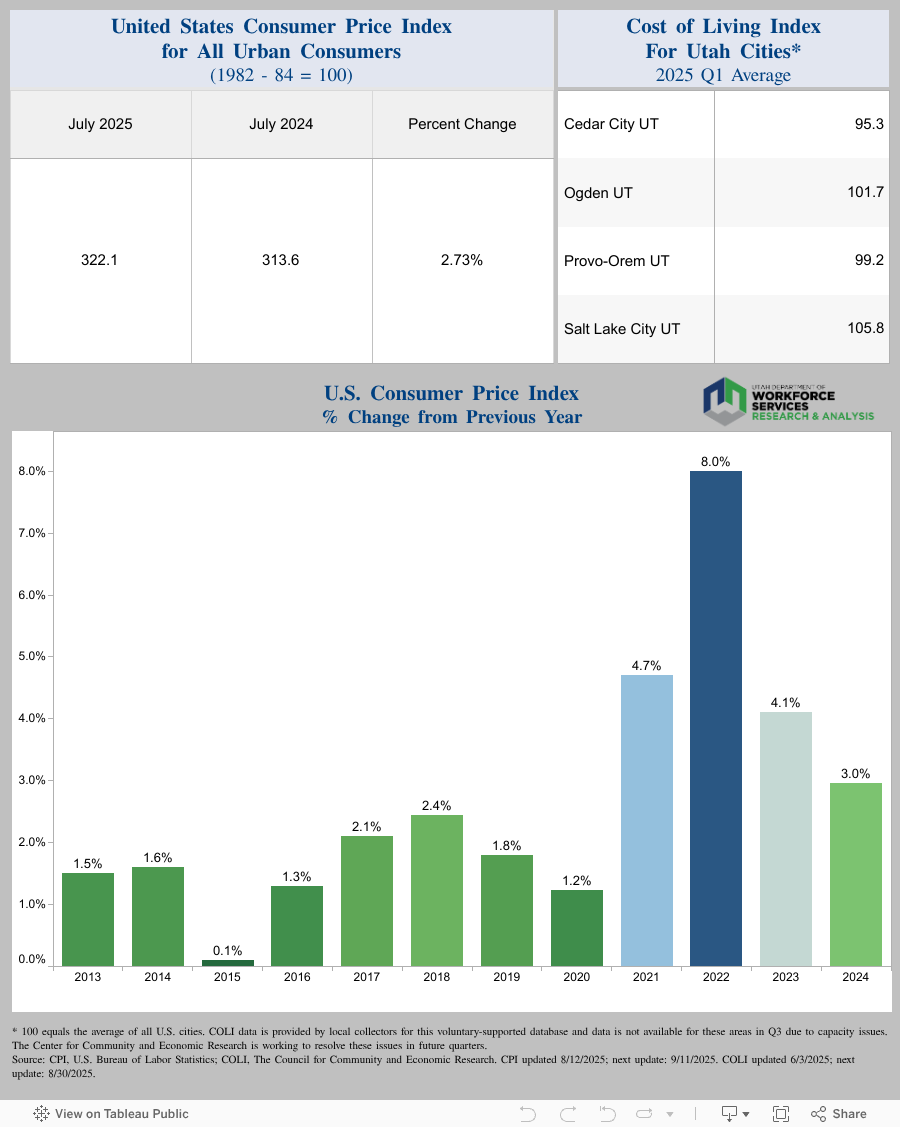
Consumer Price Index (CPI) and Cost of Living Comparisons
The Consumer Price Index (CPI) is a measure of the average change over time in the prices paid by urban consumers for a market basket of consumer goods and services. The index is set to 100 in the base period of 1982 - 1984, so a current index level of 200, for example, would suggest that prices have increased 100 percent since that time. There is no CPI data specific to Utah, so we rely on the national data.
While the CPI shows changes in prices across time, the cost of living comparisons show us differences in prices across geographies. The total cost of a standard set of goods and services is determined for a particular region and then compared to the cost for the same set of goods and services for the US on average. So a cost of living comparison of 95 percent in Salt Lake City, for example, would suggest that it costs 5 percent less to live in Salt Lake City than the rest of the nation on average.
The Cost of Living Index (COLI) is a quarterly comparison of prices for goods and services across participating metropolitan and micropolitan areas. Because participation is voluntary and the number and mix of participating areas can change each quarter, COLI values and the metropolitan areas highlighted may vary from one report to another. The COLI is intended to show relative differences in the cost of living across areas at a specific point in time, rather than measure inflation or changes in prices over time.
Related Link: Downloading Tableau Data | Historical CPI data | Calculating Inflation-Adjusted Wages | More About CPI